EIS: What Changes When Your Company Grows Beyond SEIS
22 July 2026 · 8 min read
 Milan Bilimoria
What EIS is and who it is for
The Enterprise Investment Scheme has been in place since 1994 and is designed for companies that are past the very earliest stage but still early enough to represent genuine investment risk. Where SEIS is capped at £250,000 of company fundraising and requires a company to have been trading for less than three years, EIS opens significantly larger doors: a company can raise up to £5m per year under EIS, with a £12m lifetime limit, and the trading age limit extends to seven years, or ten years for knowledge-intensive companies.
The company eligibility criteria also reflect a more developed business. Gross assets must be no more than £15m before the investment and £16m after. The company must have fewer than 250 full-time equivalent employees, or up to 500 for knowledge-intensive companies. It must be unquoted, UK-established, and carrying on a qualifying trade that does not substantially consist of HMRC-excluded activities.
Think of SEIS and EIS as two rungs on the same ladder. SEIS is the first rung: tiny company, tiny raise, maximum government support to compensate for maximum risk. EIS is the second rung: more established company, larger raise, still significant government support but calibrated to a different risk profile. The reliefs are less generous on a percentage basis, but the amounts involved are substantially larger.
On the investor side, the annual investment limit under EIS is £1m per tax year, rising to £2m if at least £1m is directed toward knowledge-intensive companies. The income tax relief rate is 30%, compared to 50% under SEIS. Shares must be held for at least three years to retain the reliefs, and the investor must not be connected with the company, which for EIS means they cannot be an employee or director at the time of investment — unlike SEIS, where directors can invest in their own company.
The income tax relief: how it changes the cost of investing
The mechanics of EIS income tax relief work identically to SEIS, just at a different rate. An angel investing £50,000 into an EIS-qualifying company claims 30% income tax relief: £15,000 back off their tax bill. Their effective cost of making the investment is not £50,000. It is £35,000.
Same principle as SEIS, different numbers. The government still subsidizes the entry cost, just less aggressively, since the company carries less risk than a pre-revenue SEIS company. The tradeoff is substantially more capital available with meaningful relief.
This relief is claimed through self assessment for the tax year in which the shares were issued, with the same option to carry back to the previous tax year. The investor receives an EIS3 certificate from the company after HMRC has approved the compliance statement, which they use to make the claim.
Scenario modelling: what an angel actually risks under EIS
The following is modelled on a £50,000 EIS investment from a higher rate taxpayer at 45%. The investment is within the £1m annual investor limit and the company is raising within the £5m annual company limit.
Starting point: income tax relief
£50,000 × 30% = £15,000 income tax relief. Effective cost after relief: £35,000.
Scenario A: The company succeeds
The company exits four years later at a 4x return. The investor's £50,000 of shares are now worth £200,000. The £150,000 gain would normally attract CGT at 24% for a higher rate taxpayer: a tax bill of £36,000.
Under EIS disposal relief, provided the investor has held the shares for at least three years and the income tax relief has not been withdrawn, the gain on disposal is exempt from CGT. Zero tax on £150,000 of gains.
Get in at reduced effective cost, keep everything on exit. On a £50,000 investment with a £35,000 effective cost, a 4x exit produces £200,000 proceeds with no CGT liability — £165,000 net gain on £35,000 outlay.
Without EIS, the same investor would net £164,000 after CGT on the same exit: £200,000 proceeds minus £36,000 CGT. The difference is £36,000, produced entirely by the disposal relief.
Scenario B: The company fails
The company goes under. Shares are worthless. Here is the recovery sequence:
- Income tax relief already claimed: £15,000 recovered
- Remaining net loss: £35,000
- EIS loss relief at 45% marginal rate: £35,000 × 45% = £15,750 additional recovery
- Total recovered: £15,000 + £15,750 = £30,750
- Real loss on a £50,000 EIS investment that went to zero: £19,250
An angel investing £50,000 in an EIS-qualifying company risks £19,250 in the worst case — a 61.5% downside reduction. Significant protection, though less dramatic than SEIS's 72.5%, reflecting the lower relief rate and the more developed company stage.
The practical consequence for a fundraising conversation is the same as with SEIS: the investor who has not run this calculation is overestimating their downside, and the founder who can show them the real numbers is having a different conversation from the one most founders have.
Scenario C: CGT deferral relief
This is where EIS differs most meaningfully from SEIS, and where it becomes particularly interesting for a specific type of investor: angels and family offices who have recently realised capital gains from other assets and are looking to manage their CGT liability.
Under EIS, an investor who has a capital gain from any asset disposal can defer that gain by reinvesting it into EIS shares. The deferred gain does not disappear: it becomes payable when the EIS shares are eventually sold. But the deferral can extend across years or even decades, and in the meantime the capital that would have gone to HMRC is working inside your company instead.
An investor sells a business and realises a £100,000 capital gain in the current tax year. They invest £50,000 into your EIS-qualifying company. They can defer the entire £100,000 gain by making the EIS investment, even though they only invested £50,000, because the deferral is not capped at the amount invested for CGT deferral purposes.
Unlike SEIS reinvestment relief, which exempts 50% permanently, EIS deferral postpones the entire gain. The distinction matters: SEIS gives a permanent CGT saving, EIS gives a timing advantage — particularly valuable if CGT rates are expected to fall before the shares are sold.
At a 24% CGT rate on £100,000, the investor who defers rather than pays immediately has £24,000 of additional working capital inside your company rather than in HMRC's hands. That is not a small number.
How EIS differs from SEIS in practice
The mechanical differences between the two schemes are clear from the numbers: lower relief rate, larger investment limits, more developed company stage, no director investment, CGT deferral instead of reinvestment relief. But the practical difference in a fundraising context is worth examining directly.
SEIS attracts first-time angels, individual investors making smaller bets, and investors who are motivated primarily by the downside protection the scheme provides. The 50% income tax relief and the £5,500 real worst-case loss on a £20,000 investment make the economics compelling even for investors who have not previously backed early-stage companies.
EIS attracts a different profile: more experienced angels writing larger cheques, family offices managing capital gains, and institutional investors who understand the mechanics well enough to model the full relief stack. The 30% income tax relief is less dramatic than SEIS's 50%, but the absolute amounts available are substantially larger and the CGT deferral relief adds a dimension that SEIS does not offer.
For a company that has grown beyond SEIS eligibility, the transition to EIS is not just a compliance change. It is a signal to the market that the company has reached a stage where a different class of investor is the target, and being able to explain EIS clearly to that investor is part of presenting yourself as a company worth backing.
If your company raised under SEIS, ensure the SEIS shares were issued before any EIS investment in the same period. The sequencing is fixed and cannot be corrected retroactively — get it wrong and the relief is removed.
What SEIS and EIS look like side by side
| SEIS | EIS | |
|---|---|---|
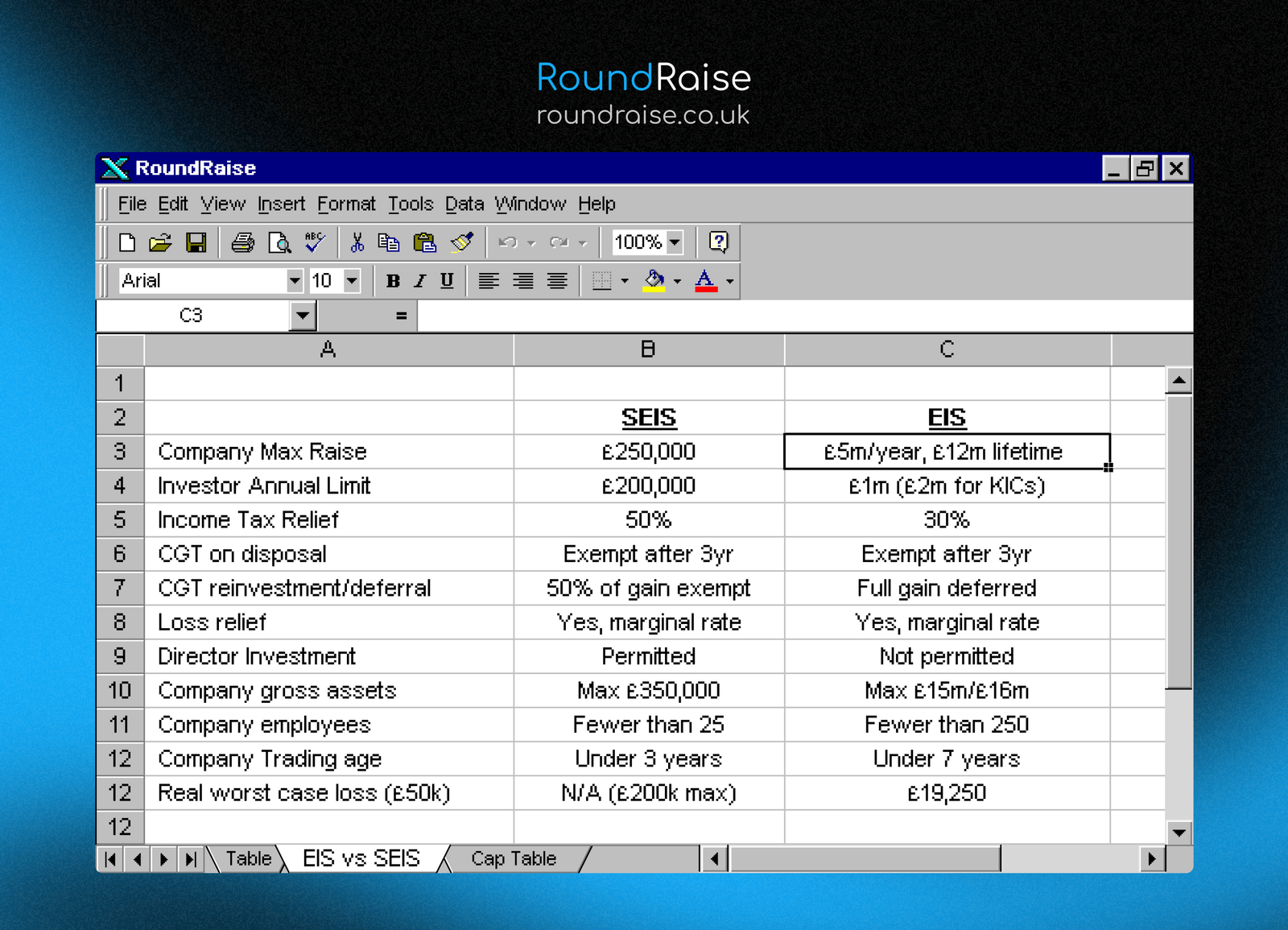
| Company raise limit | £250,000 total | £5m/year · £12m lifetime |
| Trading age limit | Under 3 years | Under 7 years (10 for knowledge-intensive) |
| Gross assets | ≤ £350,000 | ≤ £15m (£16m after) |
| Employees | < 25 FTE | < 250 FTE (500 for KIC) |
| Income tax relief | 50% | 30% |
| Investor annual limit | £200,000 | £1m (£2m with KIC) |
| Directors can invest | Yes | No |
| CGT on exit | Exempt (disposal relief) | Exempt (disposal relief) |
| Relief on other gains | 50% reinvestment relief (permanent) | Deferral relief (postpones the whole gain) |
| Modelled worst-case loss | £5,500 on £20k (−72.5%) | £19,250 on £50k (−61.5%) |
The table makes the comparison clear: SEIS is higher relief on smaller amounts for earlier companies, EIS is lower relief on larger amounts for more developed ones. They are not interchangeable and they are not alternatives. They are sequential: most companies that raise under EIS have previously raised under SEIS, and understanding both schemes gives a founder the complete picture of the relief stack available across their fundraising journey.
Next week we will move on from tax relief and back into cap table mechanics. If there is a specific topic you want covered, the founder wall at app.roundraise.co.uk/board is the right place to leave it.
At RoundRaise, we build tools that help founders understand the financial structure of their round before they commit to it. If you want to model your EIS or SEIS round, you can find us at roundraise.co.uk.
We also have a founder wall at app.roundraise.co.uk/board — if something in this piece sparked a question or a thought, we would be glad to have it there.