SEIS: The Tax Relief Most UK Founders Mention and Almost None Explain
16 July 2026 · 10 min read
 Milan Bilimoria
Ask most UK founders whether their company qualifies for SEIS and they will say yes. Ask them to explain what SEIS actually does for the investor sitting across from them, mechanically, in pounds, across each possible outcome, and the answer gets considerably vaguer.
That is a missed opportunity. SEIS is one of the most powerful tools available to a UK pre-seed founder in a fundraising conversation, not because it is complex or impressive to mention, but because it fundamentally changes the risk calculation for an angel investor in a way that most founders never articulate clearly. When you understand what it does mechanically, you understand why having SEIS advance assurance in place before approaching angels is not just a nice-to-have. It is a commercial advantage that directly affects who will take your call and on what terms.
This piece covers what SEIS actually does, modelled precisely, across the scenarios that matter. By the end of it you should be able to explain to any investor exactly what their effective cost of investment is, what their downside exposure looks like in the worst case, and what their tax-free upside looks like if the company succeeds. That conversation, done well, is materially different from saying "we're SEIS eligible" and moving on.
What SEIS is and who it is for
The Seed Enterprise Investment Scheme is a UK government programme designed to encourage private investment into very early-stage companies by offering individual investors a set of tax reliefs that make the risk-adjusted economics of investing significantly more attractive than they would otherwise be.
To qualify, your company must meet a specific set of criteria at the time shares are issued. The company must have gross assets of no more than £350,000 and fewer than 25 full-time equivalent employees. It must have been trading for less than three years and must not have previously raised investment through EIS or a Venture Capital Trust. The maximum a company can raise under SEIS is £250,000 in total, which makes it specifically a pre-seed instrument: it is designed for the very first institutional capital a company takes, before it has the track record, the assets, or the scale to access EIS.
Think of SEIS as a government subsidy for the highest-risk end of the investment spectrum. In exchange for backing a company that is less than three years old, has almost no assets, and might have nothing more than a product and a founder, the government steps in and significantly reduces the investor's real financial exposure. The riskier the investment, the more the scheme does to offset that risk.
On the investor side, income tax relief is available at the rate of 50% on investments of up to £200,000 per tax year. The investor must be a UK taxpayer, must not hold more than 30% of the company's shares or voting rights, must not be an employee of the company, and must hold the shares for a minimum of three years to retain the reliefs. One useful detail worth knowing: directors can invest in their own company under SEIS, which is not permitted under EIS.
The income tax relief: what it actually does to the cost of investing
The headline relief is 50% income tax relief. In practice this means the following. An angel investor puts £20,000 into your SEIS-qualifying company. They claim 50% income tax relief: £10,000 comes back off their tax bill. Their effective cost of making the investment is not £20,000. It is £10,000.
Imagine paying £20 for something and immediately getting £10 back from the government. You now own the thing, but you only spent £10 to get it. That is what income tax relief does to an angel's cost of investing in a SEIS-qualifying company. The cheque they write is £20,000. The amount they actually part with, net of tax, is £10,000.
This relief is not deferred or contingent on a future exit. It is claimed through self assessment for the tax year in which the shares were issued, or carried back to the previous tax year if the investor prefers and has unused capacity. The practical effect is that within months of making the investment, the angel has already recovered half of their outlay through their tax return.
Most founders mention this and move on. The number that actually matters in a fundraising conversation is not the 50% headline rate. It is what the investor's total financial exposure looks like across every possible outcome from the point of investment onward. That requires modelling three scenarios, not one.
Scenario modelling: what an angel actually risks
The following is modelled on a £20,000 SEIS investment from a higher rate taxpayer at 45%. The investment is well within the £200,000 annual investor limit and the company is raising within the £250,000 company cap.
Starting point: income tax relief
£20,000 × 50% = £10,000 income tax relief claimed immediately. Effective cost after relief: £10,000.
Every subsequent calculation starts from this number. The investor has £10,000 of real money at risk, not £20,000. That is the foundational shift in how the risk conversation should be framed.
Scenario A: The company succeeds
The company exits five years later at a 5x return on the original investment. The angel's £20,000 of shares are now worth £100,000. Under normal circumstances, the £80,000 gain would be subject to capital gains tax at 24% for a higher rate taxpayer, producing a tax bill of £19,200.
Under SEIS disposal relief, provided the investor has held the shares for at least three years and the income tax relief has not been withdrawn, the entire gain on disposal is exempt from CGT. Zero tax on £80,000 of gains.
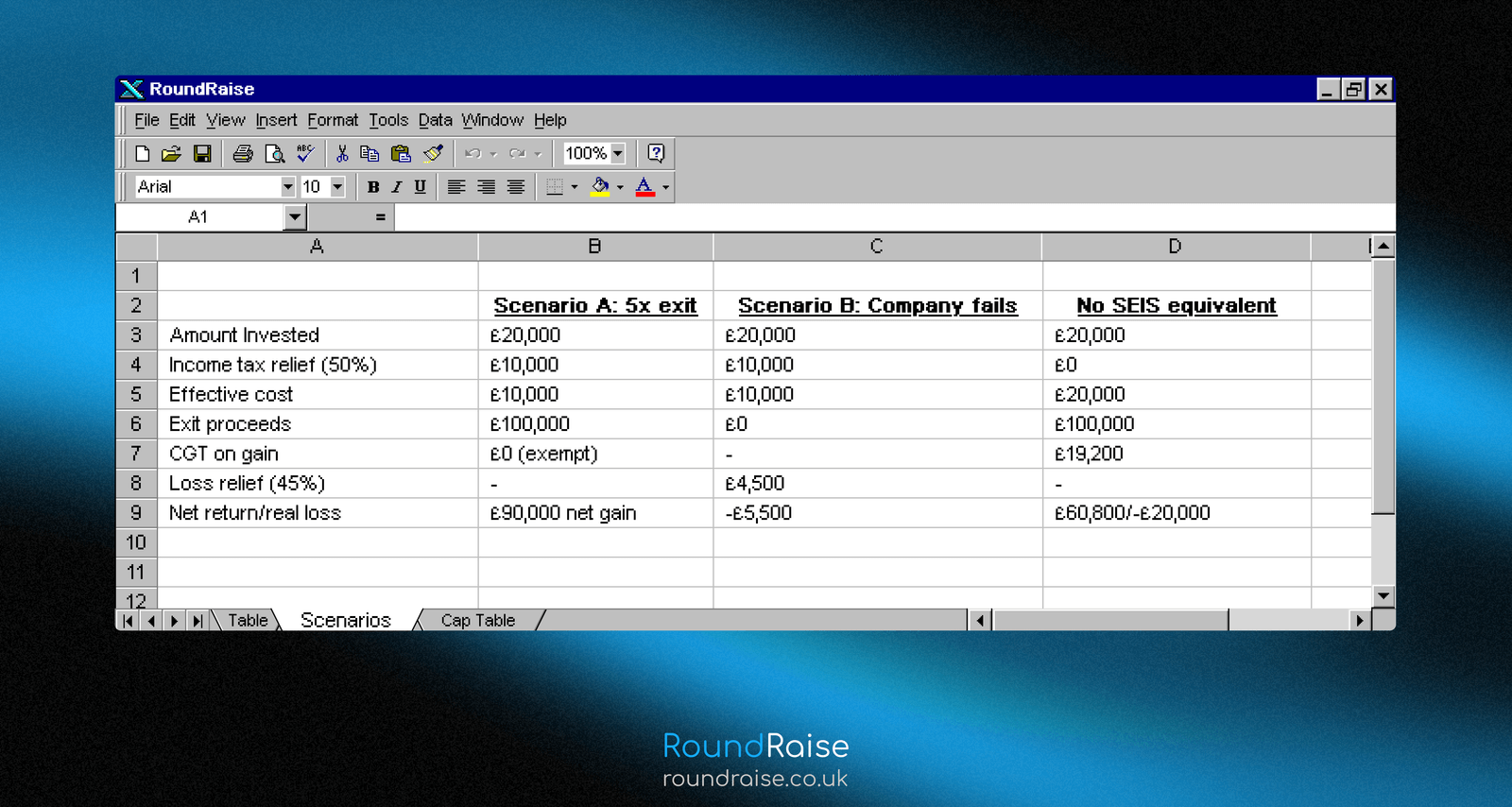
The government is not just helping the investor get in cheaply. It is also letting them keep everything on the way out. No CGT on exit means the full £100,000 return lands in the investor's pocket against an effective outlay of £10,000. That is a 10x return on money actually at risk, before accounting for any additional reliefs. Compare that to the same 5x return on a non-SEIS investment: gross proceeds of £100,000 minus £19,200 CGT minus the original £20,000 cost gives a net return of £60,800 on £20,000 invested. The SEIS version produces £90,000 net on £10,000 of effective outlay. The difference is not marginal.
Scenario B: The company fails completely
The company goes under. The shares are worthless. The investor has, on paper, lost £20,000.
Here is the sequence of what they actually recover:
- Income tax relief already claimed: £10,000 recovered
- Remaining net loss: £10,000
- SEIS loss relief: the investor claims loss relief on the net loss of £10,000 against their income at their marginal rate of 45%: £10,000 × 45% = £4,500 additional recovery
- Total recovered across both reliefs: £10,000 + £4,500 = £14,500
- Real loss on a £20,000 investment in a company that went to zero: £5,500
An angel writing a £20,000 cheque into a SEIS-qualifying company is not risking £20,000. In the absolute worst case, the company fails entirely and every penny invested is lost, they are risking £5,500. That is a 72.5% reduction in downside exposure from the headline investment figure. No other early-stage investment structure in the UK comes close to that level of loss protection for an individual investor.
This is the number that changes the investor psychology conversation. When an angel says the risk feels high for a pre-revenue company, the response is not to argue about the opportunity. It is to show them what their actual financial exposure is in the worst case scenario. Most investors who have not run that calculation have been significantly overestimating their downside.
Modelled on a £20,000 investment from a 45% taxpayer, the three outcomes look like this:
| Outcome | What happens | Investor's real position |
|---|---|---|
| At investment | 50% income tax relief on £20,000 | Effective cost £10,000 |
| Company succeeds (5× exit) | Shares worth £100,000 · £0 CGT on the gain | £90,000 net on £10,000 at risk |
| Company fails | £10,000 relief + £4,500 loss relief recovered | Real loss £5,500 (−72.5%) |
Scenario C: CGT reinvestment relief
There is a third relief that is less commonly understood but worth knowing, particularly when speaking to angels who have recently sold an asset and are sitting on a capital gain.
If an investor disposes of any asset and a gain arises, and they reinvest that gain into SEIS qualifying shares in the same tax year, they can claim to treat 50% of the gain as exempt from CGT, up to a maximum of £100,000.
An investor sells a property and realises a £40,000 capital gain in the same tax year they invest in your company. They invest £20,000 into your SEIS-qualifying round. 50% of £20,000 = £10,000 is exempt from CGT under reinvestment relief. At a 24% CGT rate, that is an additional £2,400 saving on top of the income tax relief already claimed.
SEIS is not a single relief. It is a stack of three separate mechanisms that each reduce the investor's effective cost and downside exposure from a different angle: income tax relief on the way in, CGT exemption on the gain on the way out, and loss relief if it all goes wrong. Understanding all three is what allows you to present SEIS properly in a fundraising conversation rather than just mentioning it and hoping the investor already knows what it means.
What this means for your fundraising conversation
The practical implication is straightforward. When you are raising a SEIS-qualifying round, you are not just offering an investor equity in your company. You are offering them equity in your company at half the stated price, with zero CGT on the upside, a government-subsidised floor on the downside, and the potential for additional CGT relief if they have gains to shelter.
That is a meaningfully different proposition from raising outside of SEIS, and it deserves to be presented as one rather than mentioned as an afterthought.
Having SEIS advance assurance in place before approaching investors removes a significant piece of uncertainty from the conversation. Advance assurance is HMRC's written opinion that your company is likely to qualify for the scheme, issued before the shares are distributed. It is not a guarantee — HMRC reserves the right to withdraw the view if circumstances change — but it signals to investors that you have done the compliance work and that the relief is not contingent on assumptions they cannot verify.
The compliance process after investment involves the company submitting form SEIS1 to HMRC after at least four months of qualifying trading activity or after 70% of SEIS funds have been spent. HMRC then issues SEIS3 certificates to each investor, which they use to claim the relief through self assessment.
One sequencing point to internalise before you raise: SEIS and EIS cannot be used in the same accounting period, and SEIS shares must be issued before any EIS or VCT investment in that period. If you intend to raise under both schemes as part of the same round, the order of issue matters and getting it wrong means losing SEIS eligibility for those investors. Get specific advice on sequencing before you issue any shares.
Next week we will cover EIS: how the mechanics differ from SEIS, who it is designed for, and what the relief stack looks like for a company that has grown beyond SEIS eligibility and is ready for its next raise.
At RoundRaise, we build tools that help founders understand the financial structure of their round before they commit to it. If you want to model your SEIS round or understand what advance assurance requires, you can find us at roundraise.co.uk.
We also have a founder wall at app.roundraise.co.uk/board — a space where founders leave the things they wish they had known earlier. If SEIS has changed a fundraising conversation for you, we would be glad to have it there.