So You Want to Raise From a US Investor
12 August 2026 · 7 min read
 Milan Bilimoria
Every founder wants a US cheque at some point, and it's rarely framed as anything more complicated than raising more money from a bigger, more aggressive pool of capital. Bigger rounds, better follow-on capacity, a name on the cap table that opens doors a UK angel simply can't. But it's not just a bigger pool of money you're tapping into, it's a completely different legal default sitting underneath it, and most founders don't discover that until they're already mid-conversation with a term sheet in front of them and no time left to think it through properly.
US investors, particularly at seed stage, are used to one specific setup: a Delaware C-Corp, a Y Combinator-style SAFE, US-standard board mechanics, and preferred stock protections that Delaware corporate law hands them by default without anyone having to negotiate for them. Show up with a UK Ltd and an ASA instead, and none of that maps cleanly onto what they're expecting. Their lawyer now has to rebuild, from scratch, protections Delaware would have given them for free, and that rebuild costs far too much money and time, killing your deal. Most institutional funds won't absorb that cost themselves, which is a polite way of saying it becomes your problem, not theirs.
So the actual question worth answering before you start pitching US investors isn't "should I raise from the US." It's "do I need to become a Delaware company to take their money, and if so, when." Those are two very different conversations, and conflating them is how founders end up flipping at the worst possible moment.
Do you actually need to flip?
Not always, and definitely not immediately. A growing list of US seed funds, Index, Accel, Founders Fund, a16z's crypto arm among them, will invest directly into a UK Ltd or similar entity without demanding a restructure first. But that's not universal, and it's not something you can reliably plan around. Early-stage US VCs investing into non-US companies frequently require a Delaware flip, either before the round closes or as a condition of it, and the answer usually comes down to the specific fund's LP agreement rather than anything you can negotiate away over a coffee.
In practice, the honest answer to "do I need to flip" is: it depends entirely on who you end up talking to, and you genuinely won't know for certain until you're in the room. Which, admittedly, isn't the reassuring answer anyone wants from a fundraising article, but it's the accurate one.
What flipping actually costs
A Delaware flip means creating a new US parent company, typically a Delaware C-Corp, and slotting your existing UK or EU entity underneath it as a subsidiary. Ownership shifts up to the US level. That's the mechanic, and it sounds simple enough written down in one sentence. The cost is where it stops being simple.
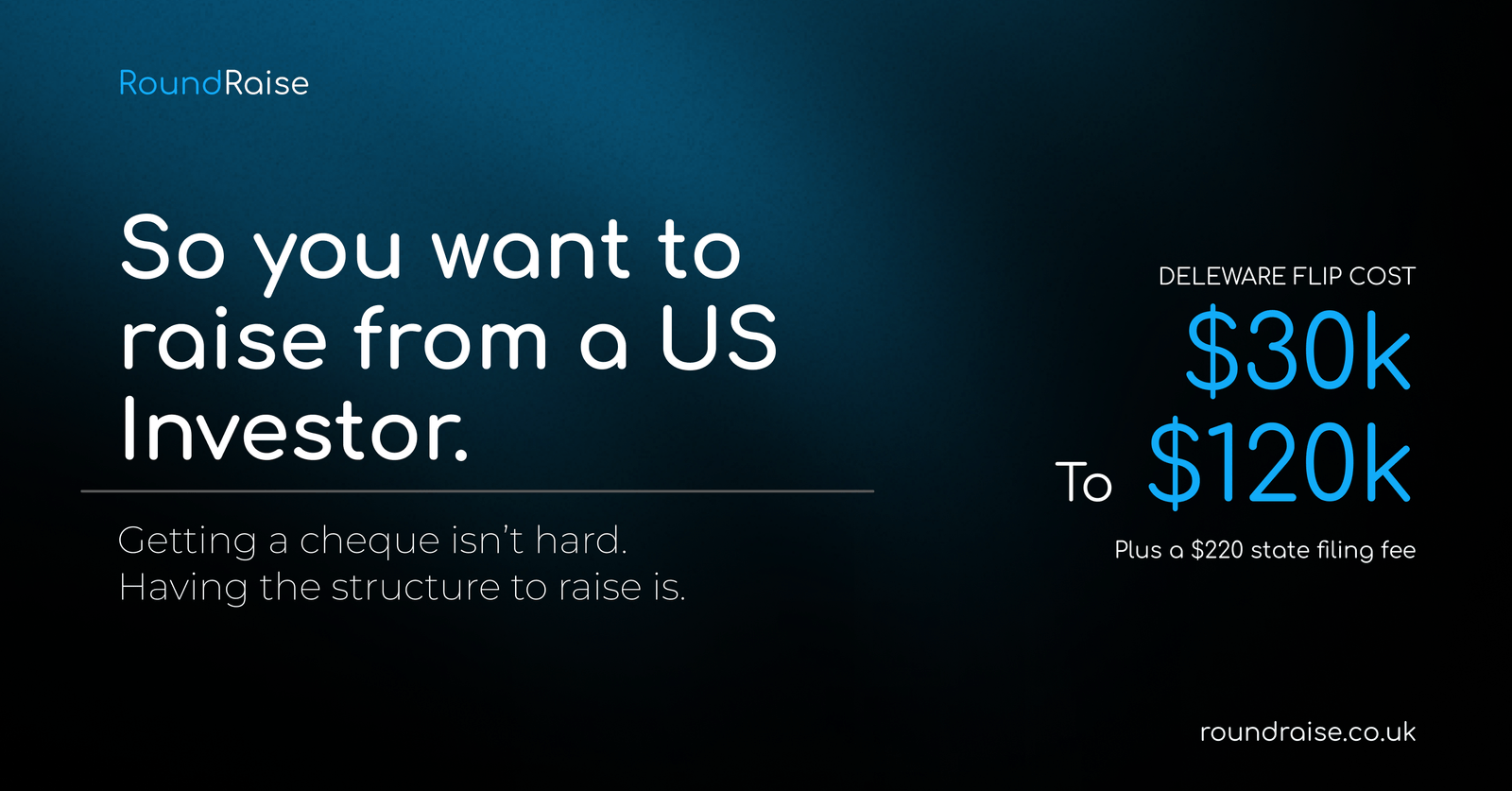
Budget somewhere between $30,000 and $120,000 in legal fees depending on where you're flipping from, plus a $220 Delaware state filing fee, which feels almost comically small sitting next to the legal bill it accompanies. UK and Canadian flips tend to land at the cheaper end of that range. If you've already got SEIS or EIS investors on your cap table, or a complex option pool with active exercises, add another 30 to 50 percent on top, because nothing about restructuring a cap table gets cheaper the more people are on it.
That's not a rounding error for an early-stage company still counting runway in months rather than years. It's a massive financial decision with an undecipherable price tag attached, and it deserves to be treated as one rather than something you back into halfway through a raise because an investor mentioned it in passing during a call, and you happened to nod "yes" to.
The three conditions actually worth checking against
Rather than trying to guess whether you'll eventually need to flip, and spending months quietly worrying about it in the background, there are three fairly reliable signals that tell you the decision has genuinely arrived rather than something you're pre-empting for no reason.
The first, and by far the clearest, is a US investor telling you directly that they want to lead or join your round but cannot invest into your current entity. That single sentence does more work than any strategic argument you could construct yourself sitting alone with a spreadsheet, because it turns the flip from a hypothetical into a gating requirement for money that's actually sitting on the table in front of you.
The second is your revenue tilting American. If most of your customers, contracts, or pipeline now sit in the US, a US parent company starts to match where your business actually operates, rather than where it happened to be founded eighteen months ago in a very different market.
The third is your realistic exit path running through American acquirers. A US buyer moves faster and pays more acquiring a Delaware C-Corp outright than it does unwinding a foreign holding structure just to get there, and acquirers notice that friction even if founders don't.
If none of those three conditions apply to you yet, flipping is premature. You'd be adding real compliance overhead and legal cost to a company that hasn't earned the need for it, solely on the assumption that some future fundraise will require it eventually. Which is a bit like buying a suit for a wedding you haven't been invited to.
The bit that matters most if you're UK-based
Here's the one that should actually make you pause, especially if you've read anything we've written on SEIS and EIS. Both schemes require the company issuing shares to be UK-established and to meet UK-specific qualifying criteria. Flip to a Delaware parent, and the entity your future investors are buying shares in is no longer the UK company those reliefs were originally built around.
That doesn't automatically mean every existing SEIS or EIS benefit disappears the instant you flip; the details depend heavily on how the restructuring is actually done and what happens to the underlying UK subsidiary afterwards. But it does mean this isn't a decision to make casually, or late, or in the excitement of finally getting a US term sheet in your inbox after months of UK meetings that went nowhere. If you've got angels on your cap table who invested specifically because of SEIS relief, or if you're planning to raise more UK angel capital before you're genuinely US-ready, flipping prematurely can close off a fundraising route you were still relying on. Get proper advice on this specifically before you sign anything.
Timing is genuinely the whole game
The best time to flip, if you're going to at all, is before you're actively raising from US investors, while your cap table is still simple and the restructuring is clean. The worst time is mid-raise, when a US lead has already made a flip a condition of the deal and you're now restructuring under real time pressure with a term sheet clock counting down in the background.
There's a middle path a lot of founders don't realise exists: take the US cheque into your current entity as it stands, and sign a side letter committing to flip at the next round instead. That buys you twelve to eighteen months to plan the restructuring properly, rather than rushing it just to close a round on time.
What actually happens if you don't flip
If you raise from a fund willing to invest pre-flip, your existing UK or EU legal documents, your ASA, your Companies Act mechanics, your UK-standard board structure, simply don't map onto what that investor's US counsel is used to seeing. That's not automatically a dealbreaker. But it does mean more legal back-and-forth than you'd get raising from a UK investor, more time spent reconciling two entirely different legal systems' worth of assumptions, and in some cases the investor's lawyers effectively building UK-specific protections from scratch rather than pulling a template off the shelf they already trust.
None of that makes raising from the US impossible without a flip. It just means the process takes longer and costs more in legal fees on both sides than it would raising from a UK investor using UK-standard documents. Worth knowing that going in, rather than being surprised by it three weeks into diligence when the legal bill starts creeping up and nobody can quite explain why.
RoundRaise won't stop you paying a US lawyer $30k to flip your company. What we can help with is the bit before that decision, knowing your cap table well enough that when the question comes up, you're not finding it out for the first time in a term sheet call.
If you're actually staring down this decision and want to talk it through rather than read another article about it, just grab a time here: Literally ask me anything.