The Board You’re Building Without Realising It
27 July 2026 · 9 min read
 Milan Bilimoria
Most founders think about their board, if they think about it at all, as something that happens later. A formality that arrives once the company feels serious enough to warrant a boardroom. That instinct is understandable, but it’s also backwards.
The board you end up with by Series B isn’t decided at Series B. It’s decided seat by seat, at every round before it, through decisions that felt minor at the time and precedents nobody framed as precedents. 84% of UK term sheets in 2025 included an investor representative on the board, and that figure rises to 91% once you include board observers. Having an investor at the table isn’t the exception anymore. It’s close to universal from Series A onwards, and understanding how that seat gets allocated, and what it actually does to your decision-making power, is worth doing well before the term sheet lands in your inbox.
This piece covers what board composition typically looks like at each stage, what determines who gets a seat, and how to think about the board you’re actually building toward rather than just the one you’re trying not to lose control of.
Seed: the board that barely feels like a board
At seed stage, most UK companies run with a minimal board. Often just the founders, sometimes with a single seed investor added once the round closes. If you’re raising on SAFEs or ASAs rather than a priced round, it’s genuinely rare for the investor to ask for a board seat at all. These instruments don’t typically carry board rights, and a seed-stage investor pushing for a full seat off the back of a SAFE is asking for something outside standard market practice. Worth knowing that, because it’s an easy line to hold.
Where a seed round is priced, or the cheque is large enough that the investor expects governance rights, the typical structure is a three-person board: two founders, one seed investor.
Think of the seed board as the first handshake on how decisions get made. It rarely changes anything day to day, because two founders on a three-person board means you can outvote the investor on almost everything. But the precedent set here, whether the investor gets a seat at all, whether it’s full voting rights or just observer status, is the template every future investor will expect to be offered.
The distinction between a director seat and an observer role matters more than most founders clock at the time. A director has full voting rights. An observer attends meetings, sees the same information, can influence the discussion, but can’t vote. A lot of experienced seed investors deliberately ask for observer status rather than a full seat, because it isn’t standard for someone writing a modest seed cheque to have direct voting control this early. If your seed investor is asking for a full seat rather than observer rights, that’s worth understanding clearly before you agree to it. Seed-stage board rights are far easier to grant than they are to remove later.
Series A: where the real negotiation happens
Series A is where board composition becomes a genuinely high-stakes conversation, because this is usually the first time you’re taking on an institutional lead who expects a seat as a condition of the investment. Market practice at Series A most commonly produces a five-member board.
Two structures show up repeatedly in UK Series A rounds, and the difference between them changes how every contested vote breaks for the rest of the company’s life.
The founder-favoured structure: two founder seats, one investor seat, one independent. Founders keep a clear majority on anything where their interests align, because you need to lose the independent AND face a united investor bloc to actually be outvoted.
The two-two-one structure: two founder seats, two investor seats, one independent. This is the most common Series A configuration in practice, and it’s a meaningfully different animal. With two founder seats matched by two investor seats, the independent’s vote decides every issue you and your investors split on. Control sits with whoever wins the independent over, not with founders by default.
Same number of investor seats added at Series A in both cases. Completely different distribution of actual control. That’s not a subtle distinction, it’s the whole ballgame, and it’s worth knowing which structure you’re being offered before you sign anything.
The independent director isn’t a neutral bystander in either version. They’re often the most consequential seat on the board precisely because their vote decides deadlocked issues. How they’re selected matters a lot. Insist on mutual agreement between founder and investor directors, not unilateral appointment by either side. An independent picked solely by your investor isn’t independent. It’s a second investor vote wearing a different jacket.
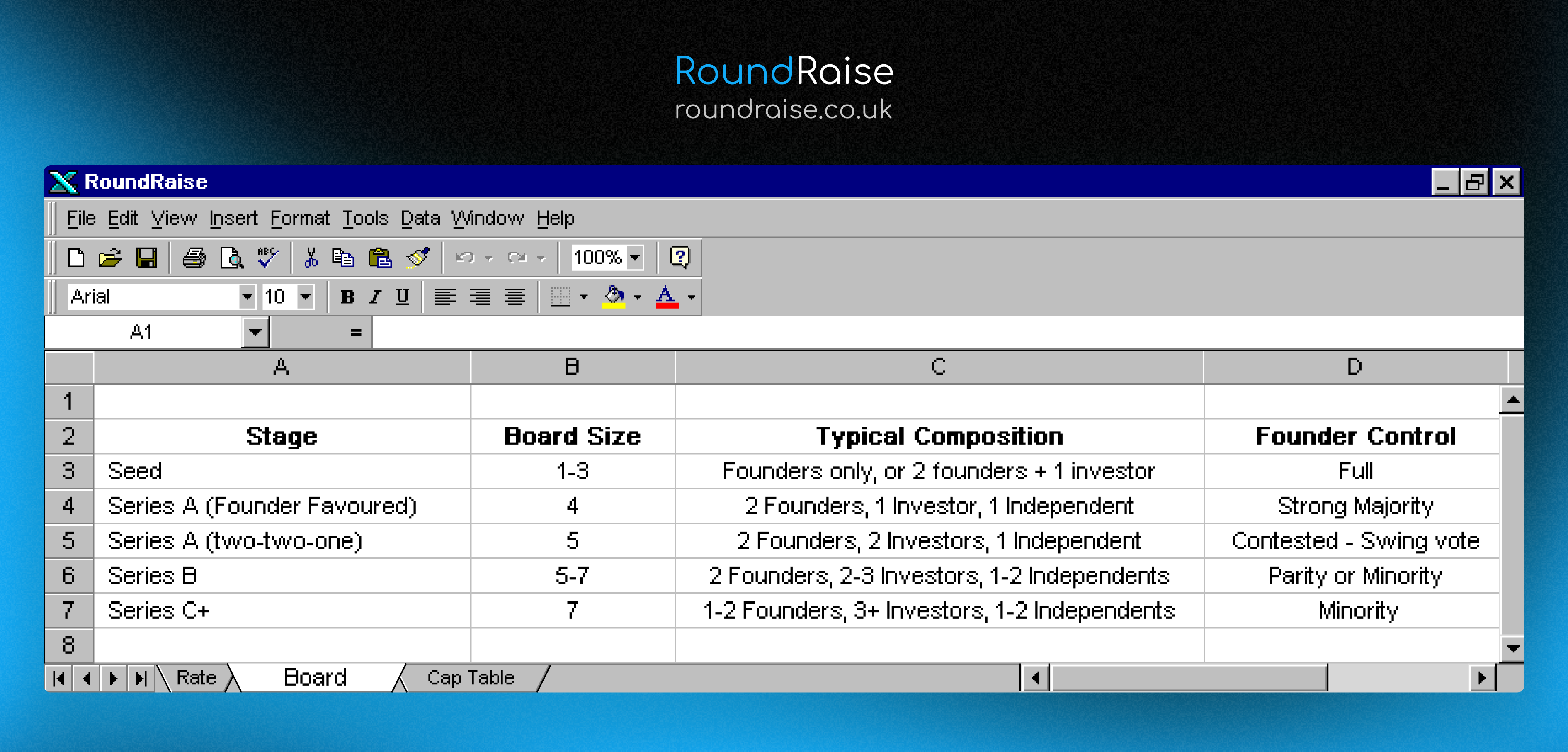
| Stage | Board Size | Typical Composition | Founder Control |
|---|---|---|---|
| Seed | 1–3 | Founders only, or 2 founders + 1 investor | Full |
| Series A (Founder Favoured) | 4 | 2 Founders, 1 Investor, 1 Independent | Strong Majority |
| Series A (two-two-one) | 5 | 2 Founders, 2 Investors, 1 Independent | Contested — Swing vote |
| Series B | 5–7 | 2 Founders, 2–3 Investors, 1–2 Independents | Parity or Minority |
| Series C+ | 7 | 1–2 Founders, 3+ Investors, 1–2 Independents | Minority |
What actually determines whether an investor gets a seat
Board seat rights are typically tied to a minimum shareholding threshold written into the term sheet. That threshold usually ranges from 1% to 10% of issued voting capital, with 5% acting as the common line for a lot of UK companies. An investor below that threshold, even one who’s written a genuinely meaningful cheque, wouldn’t normally expect a board seat under standard terms, and a request for one below the line is worth pushing back on directly.
This is a genuinely useful number to carry into a negotiation, because it turns a vague feeling, “should I give them a seat?”, into a concrete test: does their ownership actually clear the threshold we’ve set? If it doesn’t, the market-standard answer is observer rights, not a vote, and you’re within your rights to say exactly that.
Series B and beyond: where founder control tends to erode
As companies push into Series B and later, boards tend to expand and the balance shifts further away from founders by default. A common Series B structure adds a second investor seat for the new lead, while founder representation typically stays at two rather than growing with the round size. By Series C, seven-member boards with three or more investor seats aren’t unusual.
Founders hold the majority through seed and usually through Series A. Investors gain parity around Series B. Independent seats tend to grow from Series C onward as the board professionalises. The shift from a three-seat board at seed to a five-seat board at Series A is where most founders lose real leverage for the first time, because that’s the point the independent stops being a formality and becomes the swing vote.
And here’s the bit worth actually sitting with rather than skimming past: your seed-stage board sets the precedent for every board conversation after it. Adding investor seats gets easier each round, because you’re just matching what came before. Taking one away, or renegotiating an observer role back down after it got upgraded to a full seat, is a different job entirely, because now you’re asking someone to give something up instead of just matching precedent. The board you want at Series B starts with the board you agree to at seed.
Worth remembering too: plenty of founders have lost their own company through exactly this mechanism, usually because they never modelled the vote count until the vote actually happened. There’s a well-worn story in every ecosystem about the founder who got ousted from the company they started, and it’s rarely a single dramatic betrayal. It’s normally just years of board seats stacking up in one direction while nobody was counting.
Building the board you actually want
None of this is an argument against giving investors board representation, which would be unrealistic and, honestly, often counterproductive. A well-chosen investor director brings real value: pattern recognition across their other portfolio companies, credibility with future investors, and often genuinely useful help navigating problems they’ve already seen play out elsewhere.
The argument is for treating board composition as a deliberate structural decision from round one, rather than something negotiated reactively, term sheet by term sheet, with no clear view of where it’s heading. A few things worth carrying into every round:
Insist on mutual agreement for independent selection. Every time, every stage. An independent picked unilaterally by one side isn’t independent.
Know the shareholding threshold that triggers board rights in your specific term sheet, and hold investors to it. Below the line, observer rights are the market standard, not a vote.
Think about the structure you’re building toward, not just the seat you’re being asked to grant today. A two-two-one board at Series A is a completely different company to run than a founder-favoured three-two-one board, even though both technically have five seats and both technically give founders “two seats.”
And keep board seats and protective provisions conceptually separate. A protective provision, investor consent required on major decisions like a new financing round or a sale, does something entirely different to a board seat. You can hold a founder-majority board and still be boxed in by protective provisions requiring investor sign-off on the decisions that actually matter. Understanding both, and how they interact, is what actually determines how much control you keep as the company scales.
The board you have at Series B or Series C isn’t a surprise that happens to you. It’s the accumulated result of every board conversation since the company was three people around a table. Build it deliberately, from the first seat onward.
Somewhere down the line, the board you’re building today will vote on something you care about deeply, and you might not win. That’s not a scare tactic, it’s what a board is for. The only real question is whether the structure you agreed to gives you a fighting chance when it happens, or whether you gave that away years earlier without noticing.
At RoundRaise, we build tools that help founders model board control and dilution round by round, long before the term sheet lands. If you want to see where control actually sits as you scale, you can find us at roundraise.co.uk.
We also have a founder wall at app.roundraise.co.uk/board. If a board conversation has caught you off guard before, that’s exactly the kind of thing worth leaving there.