Your Investor's Tax Bill is Your Problem Too
19 August 2026 · 8 min read
 Milan Bilimoria
TL;DR
- US investors want you in Delaware for more than paperwork comfort. It's the only structure that unlocks QSBS, a US tax exemption on exit proceeds.
- QSBS changed on 4 July 2025. Old rule: a hard five-year cliff for 100% tax exclusion. New rule: tiered, 50% at 3 years, 75% at 4, 100% at 5.
- Same investment, same exit, same three-year hold, issued before vs after that date: roughly $142,000 difference in tax owed.
- The exclusion clock starts when your Delaware entity issues the shares, not when you founded the company. Flip early, and every investor gets the full runway toward it.
We wrote last week about Delaware flips, restructuring a UK or EU company into a US Delaware entity to raise from American investors. We covered when you actually need to do it, what it costs, and why doing it under pressure mid-raise is worse than doing it early. What we didn't get into properly is why a lot of US investors push for it so hard in the first place, and it's not really about paperwork familiarity or lawyers preferring documents they've seen a thousand times before.
It's about a specific piece of the US tax code that most UK founders have never heard of, called QSBS. And it just changed dramatically, in a way that makes the case for flipping early even stronger than it already was.
What QSBS actually is, in plain terms
Start with the basic idea, because none of this makes sense without it. When someone in the US sells shares in a company and makes a profit, that profit is normally taxed as a capital gain, like anywhere else. QSBS is a specific exemption that lets certain investors avoid paying some or all of that tax, provided a few conditions are met. It stands for Qualified Small Business Stock, and it's been sitting in the US tax code since 1993 under a section called 1202.
The conditions matter here. The company issuing the shares has to be a domestic C-Corp, which is a specific type of American company structure, generally set up in Delaware for startups. A UK Ltd doesn't qualify. Neither does a German GmbH, or a French SAS, or anything that isn't genuinely American. Furthermore, the investor has to actually hold the shares for a set period of time before selling, because the whole point of the relief is to reward people for backing a company early and staying in for the long haul, not for flipping shares quickly.
So in short: an American tax break, only available on shares in an American company, only if you hold them long enough. That's the whole concept. Everything else is detail.
What changed on 4 July 2025
Before last summer, the rule was blunt and unforgiving. Hold your shares for more than five years, and you could exclude 100% of your gain from tax entirely. Hold for anything less than five years, and you got nothing. No partial credit, no sliding scale. Five years or nothing.
That cliff created a strange problem. Five years is a genuinely long time in venture terms, plenty of successful companies exit sooner than that, which meant a lot of investors who backed winning companies early still ended up with a full tax bill, purely because their exit happened to land at year four rather than year five.
The new law, passed as part of something called the One Big Beautiful Bill Act, replaced that all-or-nothing cliff with a proper sliding scale, and only for shares issued after 4 July 2025. Hold for three years now, and you can exclude 50% of your gain. Hold for four years, and it's 75%. Hold the full five years, and you still get the whole 100%, same as before. On top of that, the maximum amount of gain you're allowed to exclude went up too, from $10 million to $15 million per investor, and the size limit for what counts as a "small business" eligible for any of this rose from $50 million to $75 million in company assets.
Picture it like a loyalty scheme with a much lower bar to start earning rewards. Before, you needed a five-year membership card before you got anything back. Now you start earning real rewards after three years, and the longer you stay, the more you get, right up to the same maximum as before.
Genuinely one of the more generous pieces of tax legislation to land in a while, and not a sentence that gets written about the US tax code very often.
What this actually looks like with real numbers
Here's where it stops being abstract. Say an angel investor puts $200,000 into a Delaware C-Corp at seed stage. The company does well, and a few years later they exit at a 10x return, turning that $200,000 into $2,000,000. That's a gain of $1,800,000, and the question is how much of it the investor actually keeps once tax is accounted for.
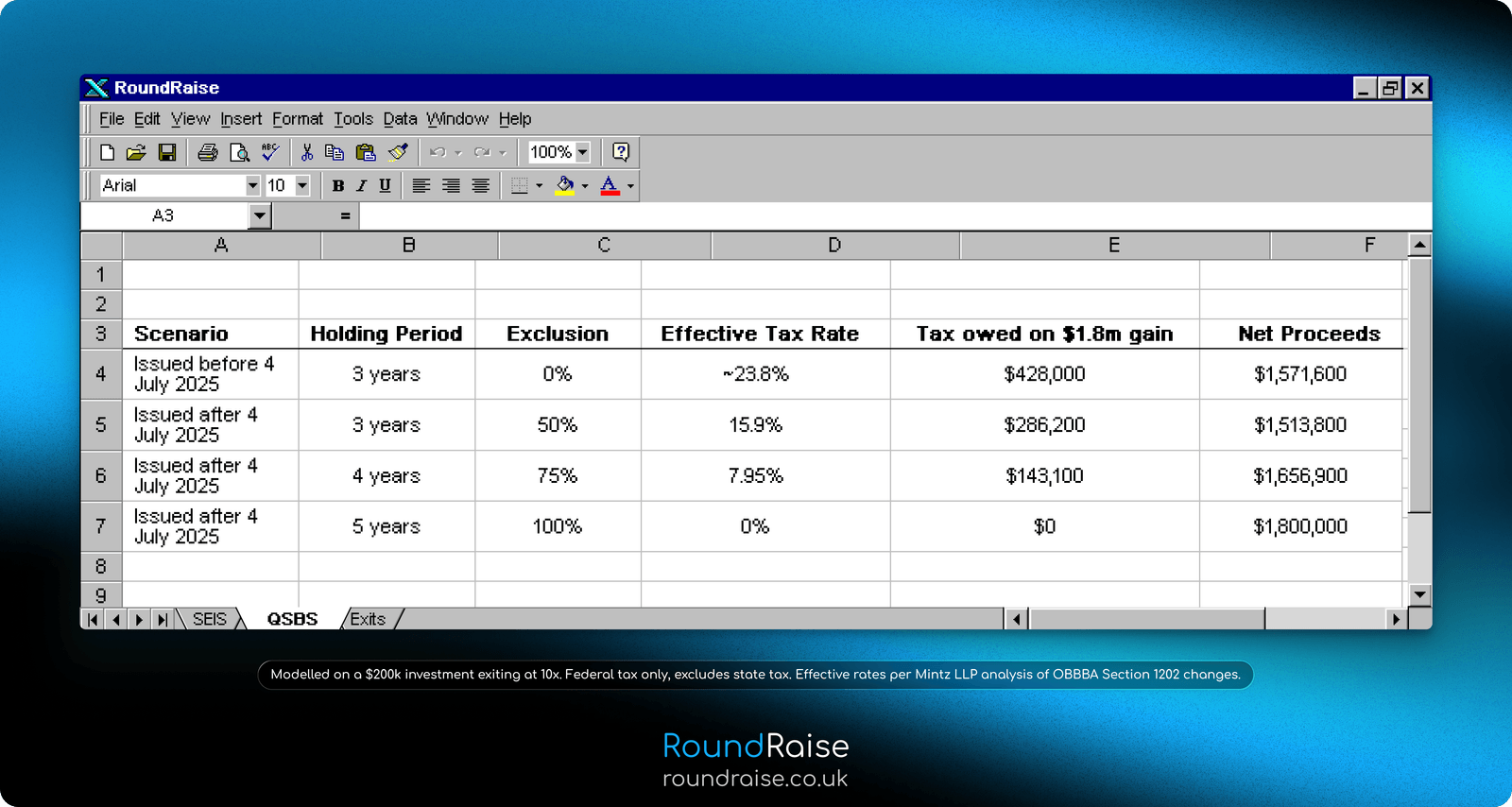
If those shares were issued before 4 July 2025, and the investor sells after exactly three years, none of that gain qualifies for any exclusion under the old rules, because three years falls short of the five-year cliff. Standard tax rules apply instead, which for a US investor works out to roughly 23.8% once you include a related tax called the net investment income tax. That's about $428,400 owed on this one exit.
Now imagine the exact same investment, same company, same exit, same three-year hold, but the shares happened to be issued after 4 July 2025 instead. Under the new tiered rules, three years now qualifies for that 50% exclusion, and the effective tax rate on the whole gain works out to 15.9%. That's roughly $286,200 owed instead.
On a $1,800,000 gain, the only variable being when the shares were issued and how long they are held, the difference is stark:
| Shares issued & hold period | Gain excluded | Tax owed on $1.8m gain |
|---|---|---|
| Before 4 Jul 2025 · 3-year hold | 0% (under the 5-year cliff) | ~$428,400 (23.8%) |
| After 4 Jul 2025 · 3-year hold | 50% | ~$286,200 (15.9%) |
| After 4 Jul 2025 · 4-year hold | 75% | ~$143,100 |
| After 4 Jul 2025 · 5-year hold | 100% | $0 |
Read that again slowly, because it's worth it: identical investment, identical exit, identical three years waited. The only thing that changed is which side of a single date in July 2025 the paperwork happened to land on. And that one detail is worth about $142,000 to the investor.
Hold for four years instead of three, and the tax bill drops further to roughly $143,100. Hold the full five years, and it drops to zero. None of that is a rounding error, and it's exactly the kind of number that changes how seriously an investor thinks about your round before they've even asked about your revenue.
Why this actually matters to you, the founder
Here's the part that loops back to last week's piece, and it's worth sitting with properly rather than skimming past.
QSBS only applies to shares issued by a genuine domestic C-Corp. Not a UK Ltd, and not shares issued before your flip, even if the underlying business is doing the exact same work under the exact same team. Furthermore, the clock that counts toward that three, four, or five year holding period only starts ticking once the Delaware entity actually issues the shares. It does not start from whenever you originally founded the company, however many years ago that was.
Think of it like a race that only starts once you've actually crossed into the right country. You can't backdate the starting gun to when you first thought about running.
Which means the timing argument from last week's article gets sharper once QSBS is factored in properly. Flip early, and every investor who comes in afterward gets the maximum possible runway toward that five-year, fully tax-free finish line. Flip late, or worse, flip reluctantly halfway through a raise because a lead investor forced the issue at the last minute, and you've potentially cost every single investor in that round real time on a clock that can't be wound back once it's started.
One more thing worth knowing before you assume every Delaware C-Corp automatically qualifies: it doesn't. The company has to be actively operating in what the tax code calls a qualifying trade or business, and there's a specific list of industries excluded from that, including professional services, financial services, and hospitality among others. Most software and product companies clear this without any issue at all. But it's worth checking properly if you're anywhere near that line, because it's a genuinely bad moment to discover the exclusion doesn't apply after an investor's accountant has already modelled a tax-free exit around it.
What to actually do with this
If you're raising from US investors and weighing up a flip, QSBS is a genuinely strong thing to bring up yourself in the conversation, rather than waiting for their lawyer to explain it to you three weeks into diligence. Most experienced US angels and VCs already understand exactly what it's worth to them. Being able to talk about it fluently, when your shares would actually start qualifying, roughly what the five-year math looks like for their specific cheque size, signals the same thing that understanding your own term sheet does: that you've done the homework rather than hoping it all works out in the room.
RoundRaise doesn't file your tax return, and we're not about to start pretending we do. But knowing this exists, and roughly what it's worth before the conversation happens, changes the negotiation in your favour. That's the part we actually help with.
If you're weighing up a flip and want to talk through what it actually means for your specific cap table, book a slot with me directly: Google Calendar.